

HAYES · PEST CONTROL
Pest Control Hayes
An insect found beside incoming stock can be an isolated arrival or evidence of harbourage near warm equipment. For a Hayes warehouse or food unit, we preserve the location, identify the specimen and inspect delivery, storage and service points before defining treatment. Homes receive a separate residential assessment.
- Incoming-stock evidence retained for identification
- Food and equipment restrictions planned first
- Commercial monitoring recorded by zone
LOCAL CONTEXT
Is the insect arriving with stock or living nearby?
Hayes is an outer west London town on major transport routes near Heathrow and the M25 corridor. Terraced housing and managed developments sit alongside warehouses, retail units and food premises, but this mix does not demonstrate any local pest rate. The featured customer situation is insects appearing around cartons after delivery. Staff isolate affected goods under their site procedure and record the bay rather than applying spray across the store. We identify the specimen, inspect packaging damage, nearby warmth or moisture and the route from unloading to storage. Repeat captures in one equipment void support a different plan from a single insect inside a box. Targeted control, monitoring and cleaning instructions are integrated so later results remain interpretable. For rodents, door seals and lower services enter scope only when tracks or gnawing point there. Contextual links connect customers with cockroach control, commercial inspection and mice guidance.
What the inspection needs to establish
The carton or pallet where the first insect appeared Unloading path from vehicle to storage bay Warm equipment and condensation points nearby Stock rotation spaces with repeat captures Door seals only where droppings or tracks occur Staff food areas kept distinct from incoming goods
- The carton or pallet where the first insect appeared
- Unloading path from vehicle to storage bay
Prepare the relevant access
Keep a specimen or clear close photograph without direct handling. Record supplier, delivery time, pallet and bay where the insect was found. Follow the business isolation procedure for suspect goods, but do not move loose stock through unaffected storage. Provide access to equipment only after it is safely isolated by authorised staff.
Can the supplier packaging be kept for inspection?
Yes if the site can isolate it safely and retain the delivery identifiers.
When the response should move faster
Confirmed activity in exposed food, widespread insects around powered equipment or rodents contaminating dispatched goods requires prompt site action. Isolate stock under the operator’s procedure and stop unauthorised pesticide use. Product safety decisions remain with the responsible food or stock manager.
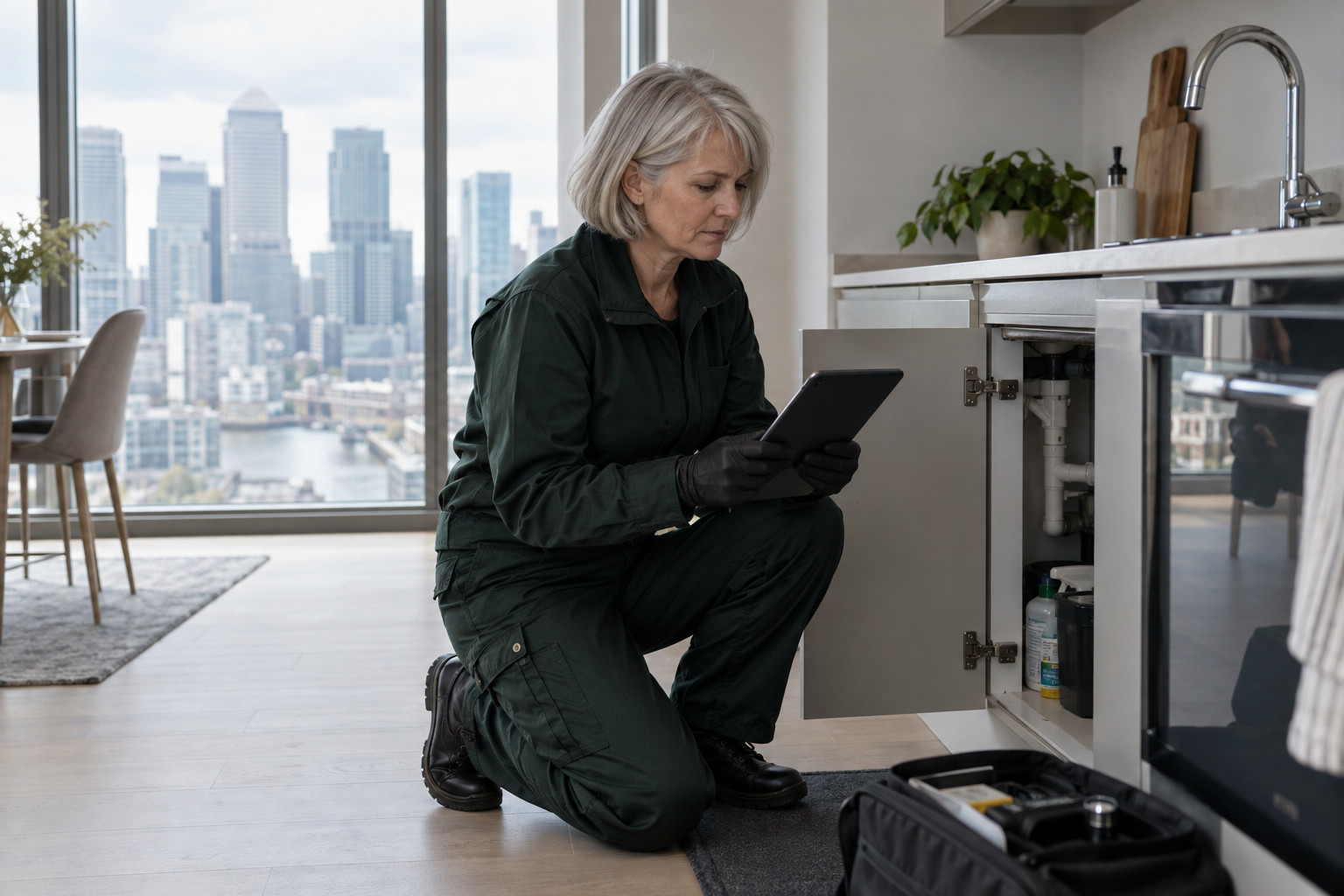
Trace the route from delivery to harbourage
Stock rotation spaces with repeat captures
Door seals only where droppings or tracks occur
Staff food areas kept distinct from incoming goods
Control matched to the evidence
Cockroaches
A specimen and harbourage evidence determine whether targeted treatment is required around equipment or services.
Stored-product insects
Affected goods, packaging and adjacent stock are examined to define the commercial response and prevent unnecessary room-wide treatment.
Mice
Tracks near loading doors or racking are mapped and controlled with protected placement suitable for operations.
Rats
Larger damage and lower-level movement are investigated through waste, doors and possible drainage links where supported.
Bed Bugs
Any report from residential accommodation is inspected around sleeping areas and kept outside the warehouse insect assumption.
A commercial chain of evidence
Preserve the commercial trace
Delivery and bay details are attached to the specimen or capture.
Identify before applying
The insect type determines which harbourage and stock questions matter.
Inspect the handling path
Unloading, storage and nearby equipment are checked in sequence.
Limit the treatment zone
Control is directed to supported activity rather than the entire warehouse by default.
Brief cleaning and stock teams
Actions are timed so they do not remove monitors or compromise treatment.
Read repeat captures
Follow-up distinguishes a one-off arrival from continuing harbourage.
A delivery-linked report that can be tested
Before
Insects are associated with stock, but the source and affected zone are unknown.
Work
The specimen, delivery trail, equipment edges and monitors establish a documented scope.
After
Repeat captures show whether activity follows new goods or persists at the site; the evidence directs revision and does not guarantee a fixed result.
Current starting prices
Define stock, equipment and room scope
| Service | Starting price | Scope factors |
|---|---|---|
| Pest inspection | From £62 | Property, access and areas inspected |
| Wasp treatment | From £89 | Nest position, height and safe access |
| Rodent control | From £184 | Activity, monitoring and visits |
| Bed bug control | From £204 | Rooms, preparation and method |
| Squirrel control | From £273 | Loft access, visits and proofing |
Final scope can change with access, activity, property size, treatment method, specialist equipment and the number of visits. Confirm the current price and inclusions before booking.
Practical local answers
Does one insect require treating the whole warehouse?
No. Identification, repeat evidence and harbourage determine the supported area.
Can equipment be opened by the technician?
Powered or specialist equipment must be made safe and opened by an authorised competent person.
Will a residential flat above a unit use the same preparation?
No. Sleeping and living space requires its own inspection, risk assessment and instructions.
Nearby coverage
Related services
Questions before booking
Why does a Hayes delivery code matter to pest inspection?
It can connect several captures to one movement of goods without assuming the building contains a breeding source.
What should staff write on an insect monitor record?
Use the device identity, date, count and condition rather than a general note that insects were seen.
Can routine wash-down continue beside treatment points?
The operator follows method-specific aftercare so cleaning does not remove or spread the applied control.
How is condensation relevant to a cockroach investigation?
Persistent moisture can support harbourage, but it is assessed alongside identification and physical evidence.
When is a specialist stock decision needed?
Suspect food or regulated goods require the responsible manager to follow applicable safety and disposal procedures.
Can repeated packaging insects be solved with proofing?
Building exclusion may help some routes, while supply, storage and stock controls can be equally important.
Operational answers for Hayes premises
Pest control in Hayes for warehouses, food premises, flats and houses. Delivery-route inspection, insect identification and documented control plans.
Call 020 3318 2099