
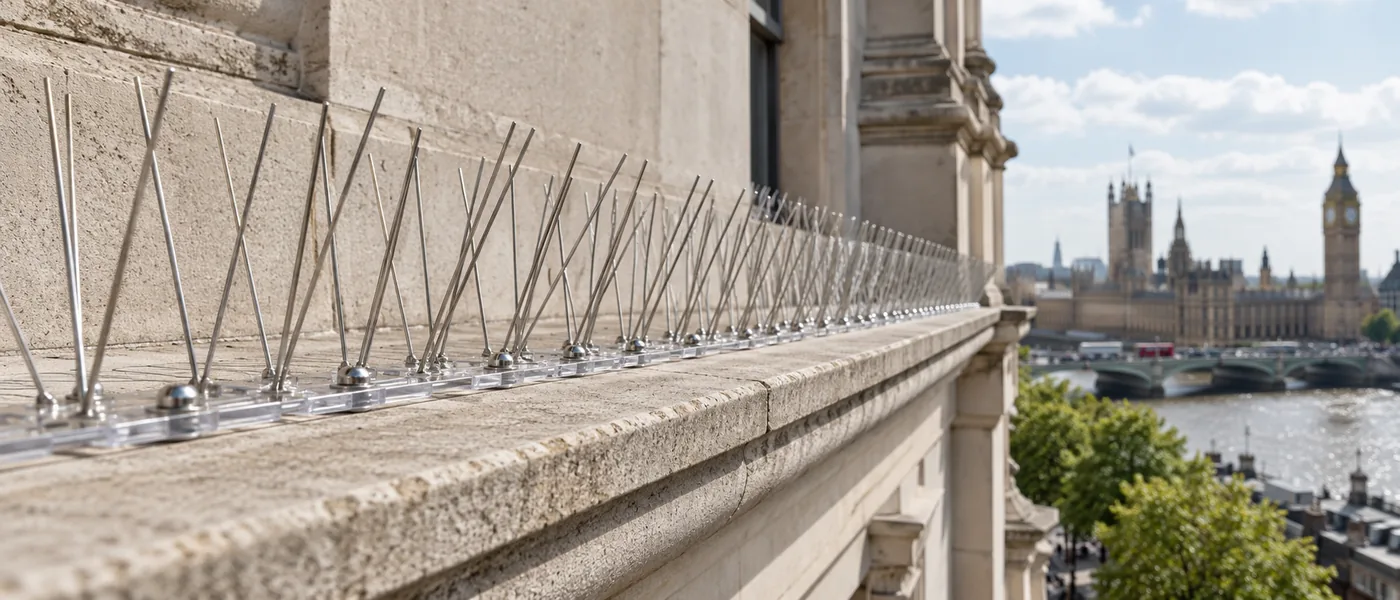
Spikes and netting are often treated as interchangeable products. They are not. Spikes can make a narrow landing surface less comfortable for birds; netting can exclude them from a larger recess or sheltered structure. Either may fail if fitted in the wrong place, and poorly maintained installations can harm birds. The decision begins with the architecture and the birds’ actual behaviour, not with a catalogue picture.
Observe where pigeons land, rest and enter. A bird walking along a sign may use it differently from one roosting beneath a canopy. Photograph the area from a safe position and note where droppings accumulate. A professional pigeon-control survey should identify the activity and check for nesting before recommending hardware.
Match the deterrent to the space
Spikes are generally considered for ledges, signs and similar linear perches. Their aim is to deny an easy landing position. They are not a useful answer to a broad covered bay where birds can stand behind the row of spikes. Nor should they be fitted to a fragile surface without considering the fixings and future cleaning. A strip that stops short of the end of a ledge can simply concentrate activity at the unprotected gap.
Netting is often used to close access to a larger volume, such as under a canopy, inside a service recess or beneath some roof structures. Its success depends on complete, carefully tensioned coverage and suitable fixings. A gap can admit birds that then struggle to escape. An installation must allow necessary building access and avoid blocking ventilation, drainage, lighting or fire-safety features.
Other methods may be more suitable in some locations. A wire system can address particular narrow perches; a change to the building detail may remove a sheltered niche. The right answer can be a combination of cleaning, food-source management and a small physical alteration rather than either spikes or netting across an entire façade.
Check for active nests before installation
In England, all wild birds, their eggs and nests are protected. Natural England says intentionally damaging or destroying a nest while it is being built or used is an offence. A deterrent must not seal birds or young into a space. An installer should check occupancy immediately before work, even if an earlier survey found no nest. Conditions can change between quotation and installation.
Ask what happens if a nest is found. The answer should describe stopping affected work, protecting the site and obtaining appropriate advice, not simply removing the obstruction. Licences exist for limited purposes, but they are not automatic permission for routine façade improvement. Timing the job lawfully may be part of the project programme.
An installation can also alter how birds use neighbouring surfaces. If pigeons are moved from one ledge to another, the cleaning and nuisance may continue. The survey should cover the relevant section of the building and any shared ownership or access issue, especially in flats or attached commercial units.
Evaluate welfare and maintenance together
Netting needs a plan for inspection. Fixings can loosen, holes can develop and debris can collect behind the barrier. A bird that finds a way in may become trapped. Ask the installer how often the installation should be checked, who can reach it safely and what the emergency response is if an animal becomes entangled. If the building owner cannot maintain it, a seemingly cheap netting system may be a poor fit.
Spikes also need maintenance. Leaves, litter and nesting material may build up between rows, creating a new platform. Adhesive can fail on dirty or unsuitable surfaces. Metal or plastic components should be checked for damage after weather and cleaning work. The installer should specify the materials and fixing method, and explain whether the substrate needs repair first.
A proposal for pest proofing should include the service life and inspection requirements, not only an installation price. Ask who owns the responsibility for removing trapped debris, replacing broken sections and checking after adjacent roof or signage work.
Consider the building as well as the birds
The visual effect matters on a shopfront or historic façade. A discreet installation may be possible, but appearance should not compromise function or safety. Check any planning, landlord or lease requirements before drilling into common parts. A listed building may need specialist property advice for external changes. Never assume a tenancy gives permission to fix devices to the façade.
Clean accumulated droppings and repair damaged material as part of the plan. Otherwise a new deterrent may hide contamination or prevent safe access to the surface. A separate cleaning scope makes costs clearer. The work method should avoid unnecessary dust exposure and protect people below. High-level access should be carried out with appropriate equipment, not improvised from a domestic ladder.
Ventilation and drainage deserve explicit checks. Netting across a vent or gutter can cause building defects and make routine maintenance difficult. Spikes fixed through weatherproofing can create leaks. Ask the installer to show where the fixings will go and how essential services remain accessible.
Questions worth asking at quotation stage
Request a marked-up photograph or drawing showing every covered surface and intentional access point. Ask what evidence shows birds use those surfaces, whether an active-nest check is included, how the site will be cleaned, what material is proposed and who maintains it. Clarify how the contractor will deal with a bird found inside the installation after completion.
Compare quotes on scope, not just headline price. A low quote that excludes access equipment, cleaning or maintenance can be more expensive in practice. Equally, a full façade system may be unnecessary if only one small ledge is used. Ask for the least intrusive design that addresses the observed behaviour.
Before accepting the work, decide how success will be measured. Fewer birds on the treated surface is useful, but continued fouling of the entrance may mean the source was misidentified. Keep a dated photograph from before installation and compare it with conditions after several weeks. Ask the contractor to inspect early if a new patch of droppings appears or if any bird is seen inside a netted space. A follow-up makes the installation a managed control measure rather than a one-off purchase.
Netting and spikes are tools, not guarantees. A suitable choice follows a survey, a lawful occupancy check and a realistic maintenance plan. If the building cannot support the fixings or the owner cannot maintain the installation, reconsider the design before work begins.
Test the installer’s maintenance proposal
Ask how a future window cleaner, roofer or sign contractor will work around the device. Netting that must be removed for routine maintenance needs a clear reinstallation method; a temporary opening left after another trade visits can admit birds. Spikes fitted across an inspection hatch may be repeatedly bent when staff open it. A good design takes these routine building tasks into account before any fixing is drilled.
Also ask for a practical emergency contact. If a bird is seen behind netting, the owner needs to know who can reach the roof safely and how quickly a repair can be arranged. Staff should not climb from windows or cut the net at random. Regular checks can be folded into the building’s existing maintenance schedule, with photographs from a safe vantage point between hands-on inspections. This keeps the deterrent effective without treating it as a fit-and-forget product.