
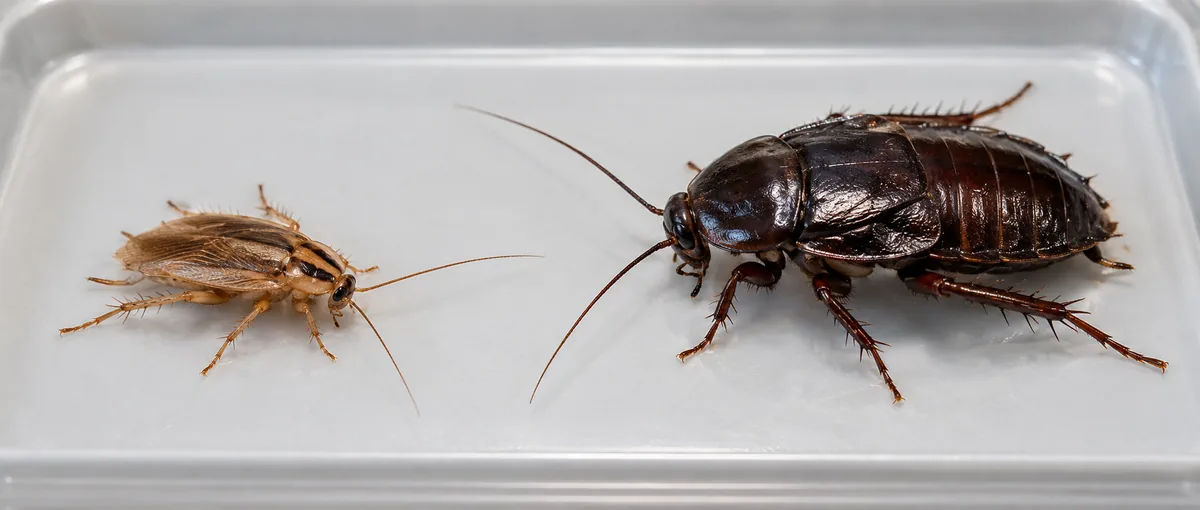
“A cockroach” is a useful first report, but it is not yet a complete plan. German and Oriental cockroaches are both encountered in UK buildings, and their typical habitats differ. A confirmed identification helps a pest controller decide where to inspect, how far activity may extend and which conditions are helping it persist. It also prevents a household from spending money treating the wrong corner of the property.
This is a guide to observing and documenting the differences, not a substitute for professional species identification. Adult insects, young stages and poorly lit photographs can look unlike the familiar images in an online chart. If possible, retain a specimen safely or provide several clear photographs with a sense of scale. Do not pick up a live cockroach with bare hands or crush it against food surfaces.
Begin with size and body pattern, then check the setting
German cockroaches are relatively small, light brown insects. Adults have two darker parallel stripes behind the head. Oriental cockroaches are generally larger and much darker, often appearing glossy dark brown to black. Females and males can differ, and juvenile stages complicate the picture. Size and colour are clues, not a verdict in isolation.
Look at where the insect was found. German cockroaches often occupy warm indoor spaces close to food and water, such as kitchens and food preparation areas. Oriental cockroaches are more often associated with cooler, damp places including basements, drains and service areas. A specimen seen beside a boiler or in a cellar should be interpreted alongside the building layout and other signs.
The BPCA's cockroach guidance describes several species and stresses that control is seldom easy. That difficulty is one reason to identify the insect before selecting a response. A warm cupboard harbourage and a damp drain route may require different inspection routes, even though both insects are called cockroaches.
Collect useful evidence without spreading it
Take a photograph from above and one from the side if the insect is stationary. Include a coin or ruler at a safe distance for scale, while avoiding contact with the insect. Note the date, time and exact place: “under the sink beside the waste pipe” is more useful than “in the kitchen”. If you can capture a specimen in a sealed clear container, label it with the location. A glue board used for monitoring may also preserve an identifiable insect, but traps should be placed with professional advice and kept away from children, pets and food.
Inspect accessible areas near the sighting for droppings, shed skins or egg cases. Photograph them before cleaning. Many household materials make dark specks, so do not announce an infestation from an unverified mark. Repeated, consistent signs near harbourages are more informative than one ambiguous spot.
If the sighting is in a flat, tell the building manager where it appeared, especially if it was near a pipe riser, shared hallway or waste area. Building-wide conditions can matter. Coordinated access to multiple units may be necessary, and early factual reporting avoids blame between neighbours. The same principle applies to a commercial kitchen with adjoining stores or delivery areas.
Why the species changes the search
A German cockroach sighting near a fridge directs attention towards warm equipment, cabinet joints and nearby food and water sources. An Oriental cockroach found near a basement drain suggests a closer look at moisture, drainage and routes from lower or external areas. Neither pattern is absolute. Cockroaches can move, and a species may turn up away from its usual shelter. The point is to allocate inspection effort intelligently.
Correct identification also matters when monitoring progress. If a treatment is followed by catches of a different species, the source and response may need review. A technician may ask whether you have noticed small insects in daytime, larger dark insects at night, or activity in different floors of a building. Your notes can shorten that investigation.
Think about the route by which the insect could have reached the sighting place. A delivery box placed beside warm kitchen equipment raises different questions from a basement sighting near damaged drainage. Do not assume either route is proven: the value is in giving the inspector a shortlist to investigate. Record recent deliveries, building works, leaks and any reports from neighbouring premises. If the site has multiple kitchens or store rooms, mark each sighting on a simple floor plan. A map is easier to interpret than a series of messages saying “another one appeared”.
Sanitation is useful for both species. Seal food, remove rubbish, clean spills and repair leaks. These steps reduce food and water availability and make signs easier to see. They do not replace control of an established population, and they should never be used to blame the occupant. Cockroaches can arrive through deliveries and move along structural routes that a resident cannot control alone.
What not to infer from one photograph
A dark insect is not automatically an Oriental cockroach. A small insect is not automatically German. An online image may be a different life stage or a different species altogether. Do not use an identification app's first label as the basis for insecticide application. Nor can you estimate infestation size from one visible insect: cockroaches shelter in gaps and may be active mainly at night.
Avoid dismantling electrical appliances, opening gas fittings or reaching into drains to obtain a better view. A technician can use safe methods and protective equipment. Do not scatter aerosol insecticide around suspected harbourages before an inspection; it may not reach concealed insects and can contaminate surfaces. Follow any product label exactly if using a lawful household product, but ask for help when activity is repeated or the setting is complex.
All Pests Gone has a cockroach control service for a confirmed problem. Its pest inspection service is relevant when the species or source remains uncertain. Share the specimen or photographs and the location log with the inspector. Ask which observations support the identification and how the proposed work addresses the likely harbourages.
A practical decision route
First, record the insect without handling it directly. Next, note the habitat: warm food area, damp basement, drain route or somewhere else. Check accessible nearby places for corroborating signs and correct obvious leaks or food storage problems. Then seek identification if the insect looks like a cockroach or further activity appears. A species name should guide an inspection, not replace it.
The difference between German and Oriental cockroaches is therefore practical, not academic. It tells you which parts of a building deserve attention and why a generic “spray the room” response may miss the source. Accurate evidence and a targeted survey are the shortest route to a defensible treatment plan.