
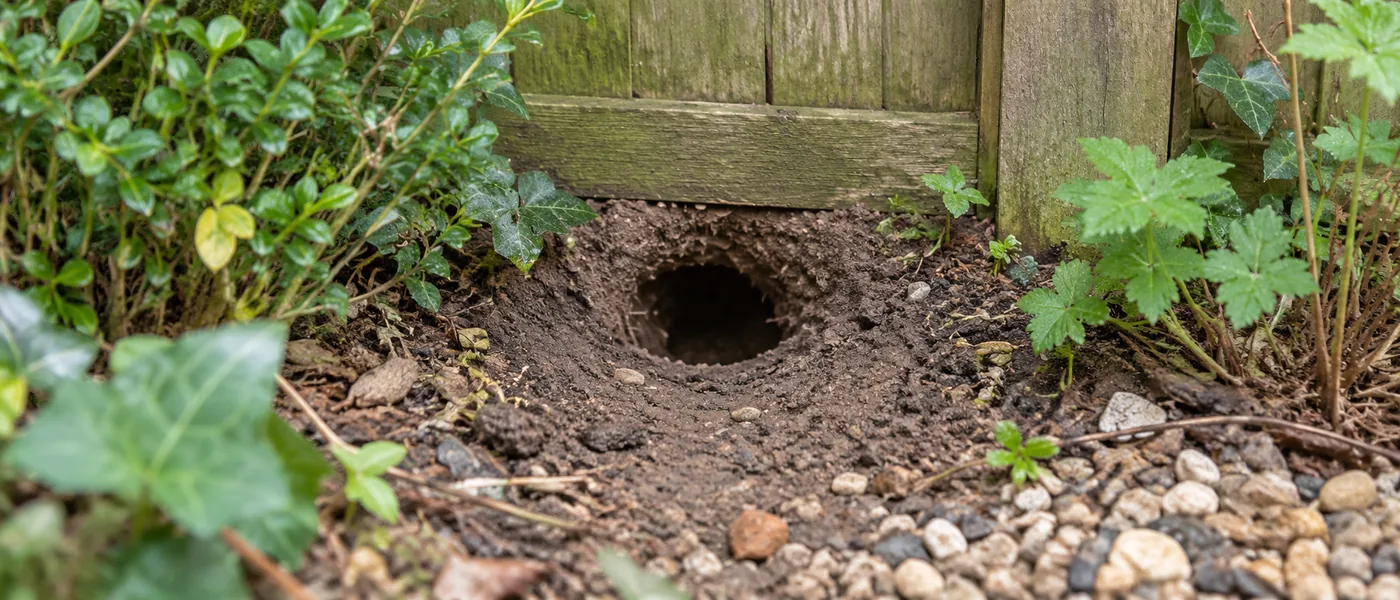
A hole beneath a fence or at the edge of a border can be unsettling, especially if a rat has also been seen nearby. Yet a garden hole is not an identification in itself. Hedgehogs, rabbits and other animals may leave signs that are easy to confuse from a distance. Before filling the opening or treating the soil, work out what evidence is actually present and whether the hole is active.
Begin with the setting, not the size alone
Look at where the opening sits. Rats may excavate in sheltered ground near a fence, hedge, compost area, shed or deck. Soil pushed out in a fan can indicate recent digging, though rain and ordinary garden work can alter its appearance. A smooth-looking route through vegetation may show repeated movement between cover and food.
It is tempting to use a single measurement to identify the occupant. In practice, soil can collapse and an entrance can be enlarged by more than one animal. Photograph the opening and the immediate area, including a reference for scale, but avoid putting your hand into it. Note whether there are several openings nearby and whether fresh earth appears after rain or garden activity.
Check the surrounding clues. Droppings, gnawing and tracks may support a rat explanation, while the absence of those signs does not conclusively rule it out. If you are unsure, ask for a pest inspection rather than assuming an animal has been identified from a photograph alone.
Observe without collapsing or blocking the hole
Choose a position from which you can see the area without standing over the opening. Dusk may reveal movement, but there is no need to wait outside for hours. A short dated observation log can be more useful than a single startled sighting. Write down what emerged, which direction it went and whether it returned to the same opening.
Avoid poking a stick into the hole, flooding it or placing a hand over it. Such actions can drive an animal into another route, create a bite risk and damage the garden without resolving the cause. Do not cover an apparently active hole with paving or concrete. If it connects to a structure, sealing one end can trap animals in a void.
Keep children and pets away from the area until it is assessed. If there are droppings, avoid dry sweeping or vacuuming them. Wash hands after working nearby and clean any tools that contacted contaminated soil. For extensive contamination, get professional advice on cleaning.
Trace the likely food and shelter
A burrow is only one piece of the garden system. Look at bins, compost, bird feeding, pet food and fallen fruit. A bin lid that does not close can provide reliable food. Spilled seed beneath a feeder can be more attractive than the feeder itself. Bags of compost or animal feed left open in a shed offer both food and shelter.
Walk the boundaries. Does the route cross under a fence? Does the hole sit beside a drain or an outbuilding? Are there gaps at the house wall that could allow an animal indoors? A tidy garden can still have rat activity if a route crosses several properties. It may be useful to speak to neighbours in a factual, non-accusatory way, especially where a shared boundary or waste store is involved.
If the hole is near a drain, repeated activity there may justify a separate drainage assessment. A surface burrow does not prove a broken drain, but a defect should not be dismissed if there are blockages, odours or subsidence as well.
Decide when professional control is warranted
Repeated sightings, fresh earth at the same opening, several possible routes or activity close to the house are strong reasons to arrange a rat control assessment. A good assessment should establish whether the burrow is being used, identify likely food sources and explain a sequence for treatment and proofing. Ask what evidence will show that activity has stopped.
Treatment choice depends on the site. The Health and Safety Executive lists hygiene, physical barriers and traps alongside biocidal products as ways of controlling rodents. Rodenticides carry risks to people, pets and wildlife; they should not be placed casually into a garden hole. Members of the public should use only products intended for general public use and follow the label. A professional may use different methods after a site-specific assessment.
Do not assume a rat problem is solved because the entrance has been filled. If food and shelter remain, new excavation may appear a short distance away. The useful result is a sustained reduction in activity and an entry route that has been addressed, rather than a neat patch of soil for one afternoon.
Plan the ground repair after activity ends
Once the animal issue has been resolved, restore the disturbed area with material suited to its purpose. Soil can be consolidated, damaged paving repaired and gaps at a structure closed with durable materials. The detail differs if the opening is in a flower bed, beneath a fence, beside a drain or at the base of a building. A wall vent and a drainage opening must continue to function; they should never be sealed merely because a rat was seen nearby.
For a recurring route, pest proofing may be needed at the building or outbuilding as well as the ground. Leave enough visibility to check the repaired area later. Dense planting and stored materials placed directly back over the opening can make fresh activity hard to notice.
Keep a short record of what was done and when. If earth reappears, a photograph taken from the same angle helps distinguish fresh activity from loose soil left by the original repair. If several openings were involved, mark them on a simple sketch of the garden.
What not to infer from a single sighting
Seeing one rat does not reveal how many are present or prove that the burrow is on your property. Conversely, not seeing an animal for a few nights does not prove a route is unused. Weather, disturbance and available food can change activity patterns. An open hole in autumn might be worth checking again after a dry spell rather than drawing a firm conclusion from one wet day.
Avoid promises of a universal remedy. A garden with a shared bin store needs different action from a garden with a damaged shed floor. The best first step is to gather reliable evidence, remove obvious attractions and assess the route before treatment or repair.
A simple decision sequence
Photograph the hole and nearby clues. Record any sightings without approaching the entrance. Check bins, feeders, compost and building edges. Keep children and pets away from the suspect area. If fresh activity persists or the route approaches the house, arrange an inspection. Complete treatment and then repair the physical access, with follow-up monitoring.
That sequence respects the uncertainty of a garden clue while still taking the possibility of rats seriously. It is more useful than identifying an animal from a hole alone, and it helps prevent repeated digging after a hurried repair.